
Wythe County VINELink Coverage
Virginia uses two connected notification routes with different custody scope. Virginia Jail VINE receives events from local and regional jails. It is the relevant route for a Wythe County detainee housed at New River Valley Regional Jail, or NRVRJ. VADOC VINE and VADOC Victim Services address state corrections custody and eligible post-sentencing or parole events. A registration in one system should not be assumed to follow a person into the other.
Local jail event types can include release, transfer, escape and recapture, or death. Some participating jails may send optional events such as work release or home electronic monitoring, but Virginia's materials say those details vary. No official source in the Wythe research confirms which optional events NRVRJ transmits. Read the live event label and do not expand it.
- Release
- The reporting custodian says its custody ended. Another authority may still have taken charge.
- Transfer
- A movement from one custodian or facility to another. It is not community release.
- Discharge
- An end point defined by the correctional record, which may refer to custody or the full correctional relationship depending on context.
- Notification
- An event message relayed from an agency feed, not a certified historical record.
Search Wythe County VINELink Records
Begin at the official VINELink search. Search one person and verify the agency before registering. NRVRJ is a regional facility in Dublin, not a building called “Wythe County Jail,” so a correct Wythe match may appear under the regional jail name.
- Open VINELink and choose Virginia. Use the current interface labels because the service may change its screens.
- Enter the person's name or identification number offered by the live form. Avoid extra filters until the search produces a manageable set.
- Compare available identity details and select the record for the right agency. Do not merge two similar names or separate bookings.
- Open the record and read its custody status, reporting facility, and event wording. Treat “transfer” and “release” as different events.
- Save the date and retrieval time. Call NRVRJ when exact release time, disposition, or destination is needed.
A name that is absent from VINELink is not proof of release. The record may use a different spelling, another agency may hold the person, an update may be pending, or the public event may no longer be available. The Wythe County released inmate search adds the regional jail, courts, VADOC, federal tools, and records-request route when VINE alone cannot settle the status.
The Virginia selection and person-search interface is shown below.
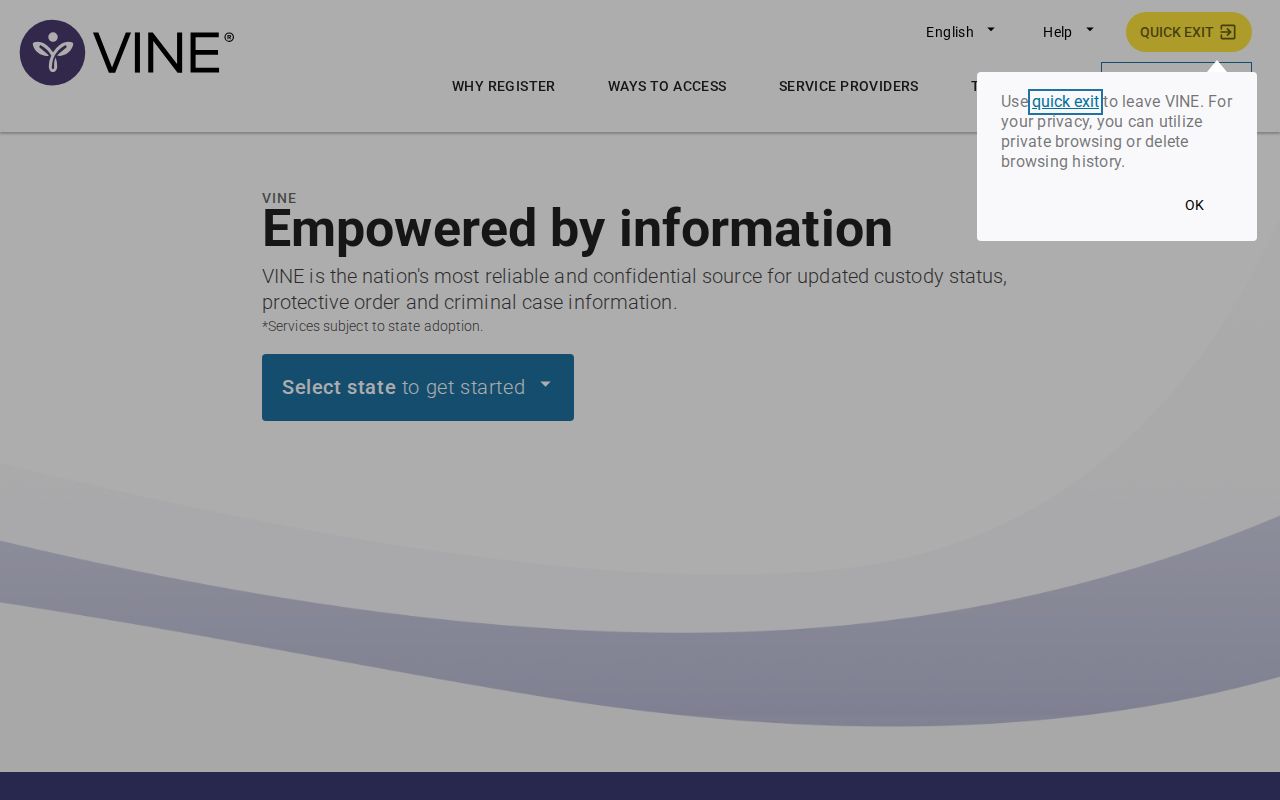
The captured screen identifies the public search route. Match its live labels and the reporting agency rather than relying on an old screenshot alone.
Wythe County VINELink Release Fields
VINELink is built around a person, an agency, current custody information, and supported events. Exact field names can change. The research supports the categories below, but it does not support promising a universal scheduled-release field or permanent display of old release events.
| Information | How to read it |
|---|---|
| Person or identification match | Helps select the intended record without assuming every same-name result belongs to one person. |
| Reporting agency | Shows whether the event comes from NRVRJ, VADOC, or another participating custodian. |
| Custody status | States the source system's current reported status, subject to source updates. |
| Facility or location | Identifies the reporting custody setting when the live record provides it. |
| Release event | Signals exit from the reporting custodian, not necessarily freedom from every authority. |
| Transfer event | Signals continued custody under a new facility or authority. |
Virginia Jail VINE is not a certified historical register. Official guidance says updates stop after release, and no public retention period for a released result was found. Save an alert or result when received, then obtain the jail release or movement record when durable proof is required.
For NRVRJ, the official inmate lookup supplies another local check through its “Include released inmates” option and Release Date column. The Wythe court docket can explain the bond, dismissal, sentence, or other legal basis. Neither a VINE message nor a court order should be made to answer a question it does not record.
Register Wythe County Release Alerts
Registration begins from the correct person record. Choose only the events and channels displayed in the live interface. The official Virginia materials describe telephone, email, and in-app options, but availability can depend on the record and the current service.
- Open the matching agency record and choose notification or registration.
- Select release, transfer, or another supported event shown for that record. Registering for both release and transfer can prevent a custody handoff from being mistaken for freedom.
- Choose a telephone, email, or app option that VINELink offers, then provide the requested contact details.
- Create a PIN for telephone calls. When VINE calls, enter that PIN to acknowledge the notice and stop repeat calls.
- Save the registration confirmation and keep the jail's contact route available for verification.
Email should not be described as requiring the telephone PIN. The PIN step applies to calls in the official workflow. Virginia VINE can also be reached at 800-467-4943 or TTY 866-847-1298 when a public user needs help with the notification service.
Contact data must be accurate enough to receive the chosen notice. A missed call, filtered email, changed number, or incomplete registration can break delivery even if the source agency sends an event. Do not use silence as evidence that custody did not change.
Review the registration after a major custody move. If the record changes from NRVRJ to VADOC, the original jail alert may have ended at transfer. If the person returns to a local jail later, a fresh local registration may be needed. Keep confirmation details private and use them only to manage the notification.
Confirm Wythe VINELink Release Events
VINE relays agency data and can lag. A released event means the reporting agency ended its custody, but the person might have moved to VADOC, another jail, USMS, or immigration custody. Call NRVRJ at 540-643-2000 for public confirmation and ask for the completed release or movement record when the precise event matters.
State-responsible cases need a separate check in the VADOC inmate and supervisee locator. An institution or local/regional placement means custody continues under state authority. A probation or parole district can show that prison custody ended while community supervision continues. The locator covers current custody or supervision and is not a full archive of discharged people.
Federal custody requires its own agency route. The BOP locator covers federal BOP custody and can show a release date or not-in-custody result for many former federal prisoners. A federal pretrial detainee housed at NRVRJ may be under USMS responsibility and not yet appear as a BOP prisoner. ICE's locator is for current immigration detention, not release history.
Note: Confirm the event with the office that created it whenever exact time, release type, or receiving authority changes the answer.
Wythe County VINELink State Handoff
The local-to-state handoff is the most distinctive Virginia VINE issue for Wythe County. A person may leave NRVRJ and enter VADOC custody. In that event, a local VINE transfer notice documents the jail movement, not community release. The receiving VADOC record becomes the next source for custody status.
Virginia's official workflow explains that a qualifying victim may need a separate VADOC notification form or call when the person moves from a jail into state corrections. If the person later returns to a local jail, registration with Jail VINE may be needed again. A registration should never be assumed to cross system boundaries automatically.
VADOC Victim Services limits its registration services to qualifying crime victims. Its office lists 800-560-4292 and victimservices@vadoc.virginia.gov, with weekday hours of 8:30 a.m. to 5:00 p.m. Public users who do not qualify can still use VINELink public information and the VADOC locator, but should not be promised VADOC Victim Services alerts.
The handoff also explains why the same name can appear in more than one source. NRVRJ records the local booking and movement. VADOC records the state authority and later institutional or supervision status. Keep the booking number and DOC identifier separate, then connect them only through matching official details.
When the state locator shows a probation or parole district, that is not a jail location. It indicates community supervision. Probation is court-ordered oversight that can follow jail or exist without prison. Parole is conditional release from a parole-eligible prison term. A VINE release alert may mark the end of confinement while the VADOC public record still correctly shows active supervision.
If both systems appear to conflict, record the exact wording and retrieval time from each. A receiving-system custody result normally shows that confinement continued after the local event. A signed release document or corrected agency response outweighs an older automated display. Ask the originating agency to explain its own event rather than choosing whichever result seems more favorable.
Note: A separate VADOC registration may be required after transfer, and a later return to jail may require local registration again.
Wythe County Release Alerts Versus Registry
The Virginia Sex Offender and Crimes Against Minors Registry is a separate post-release system for people with a qualifying legal duty to register. It is not a general inmate-release list and cannot establish the exact date a person left custody. Its “Track Offender” feature concerns certain registry-information changes, not jail custody events.
Use VINE for supported jail or corrections events. Use the registry only when the person is legally within its limited scope. Neither source replaces the originating release record, and registry information must not be used to harass anyone. The separate systems answer different questions even when both concern the same person after custody.
Note: Registry tracking concerns qualifying registration data, while VINELink tracks supported custody events from participating correctional agencies.